Iranian Cyber Threats Continue to Target Government and Higher Education in 2026
Share this post
Author
Iranian state-sponsored cyber activity is evolving — and government agencies, colleges, universities, and K-12 districts remain among its highest-value targets.
While earlier headlines this year focused on destructive attacks, the latest intelligence tells a quieter story. Iranian threat actors are shifting toward credential theft, identity compromise, and long-term espionage campaigns designed to go unnoticed for months.
For education and public sector organizations built on Microsoft 365, Entra ID, and Active Directory, the takeaway is clear: identity security and continuous monitoring now matter more than traditional perimeter defenses. The good news? Protecting against these threats doesn’t have to be complicated — and it shouldn’t pull your team away from the mission that matters.
Why This Matters for Education and Government
Nation-state attackers aren’t after your firewall. They’re after what your organization holds:
- Sensitive and grant-funded research
- Student and employee personally identifiable information (PII)
- Government records
- Microsoft 365 identities with broad access across large, distributed user populations
Rather than deploying flashy ransomware, today’s Iranian campaigns quietly establish persistence and stay hidden. That shift makes modern detection and response — not just prevention — essential.
Four Iranian Cyber Campaigns Observed Since April 2026
1. Ababil of Minab (Black Shadow)
Researchers documented continued activity associated with Iran’s Ministry of Intelligence and Security (MOIS). The campaign introduced new command-and-control infrastructure while following Black Shadow’s familiar playbook: network compromise, data theft, public leaks, and extortion. These operations often use stolen information as leverage long after the initial intrusion — which is why early detection matters so much.
2. Nimbus Manticore (Screening Serpens)
Perhaps the most significant development came from an Iranian espionage group that increasingly operates through Azure-hosted resources, legitimate cloud platforms, and trusted file-sharing services. Because most organizations already trust these services, traditional blocklists offer little protection.
For Microsoft environments, the lesson is simple: trusted infrastructure does not always mean trusted activity.
3. Government of Oman Intrusion
Another campaign showed how dangerous unpatched, internet-facing applications remain. Attackers exploited a DotNetNuke SSRF vulnerability (CVE-2025-32372) to gain access — no phishing, no stolen credentials required.
A single exposed web application can open the door to an otherwise well-secured environment. Routine vulnerability management remains one of the most effective (and most affordable) defenses against nation-state actors.
4. Seedworm (MuddyWater)
Symantec also documented continued activity from Seedworm (MuddyWater), one of Iran’s longest-running espionage groups. This campaign relied on DLL side-loading — pairing legitimate signed software with malicious code. Traditional controls trust the signed application and miss the malicious library riding alongside it.
Modern endpoint protection needs to watch how software behaves, not just whether it’s signed.
What These Campaigns Mean for Your Organization
The tactics differ, but three themes run through every campaign.
Identity is the new perimeter. Most successful attacks begin with stolen credentials, session token theft, or compromised Microsoft 365 accounts. Protecting Entra ID identities is now just as important as protecting endpoints.
Internet-facing applications remain high-risk. Web portals, legacy content management systems, and remote access services continue to draw attacker attention. Consistent patching is among the highest-value security investments you can make.
Trusted software can still be dangerous. Signed applications, legitimate cloud providers, and common administrative tools are all being abused. Behavioral analytics — not reputation alone — is what catches this activity.
Research Institutions Continue to Be High-Value Targets
Iranian threat groups — including APT34 and MuddyWater — have a well-documented history of targeting academic institutions for defense research, scientific research, intellectual property, and government-funded programs. Universities, community colleges, and research organizations should assume they remain attractive targets.
174 Indicators of Compromise Added to Guardian 365
Our team has consolidated threat intelligence published throughout 2026 into a single verified IOC package:
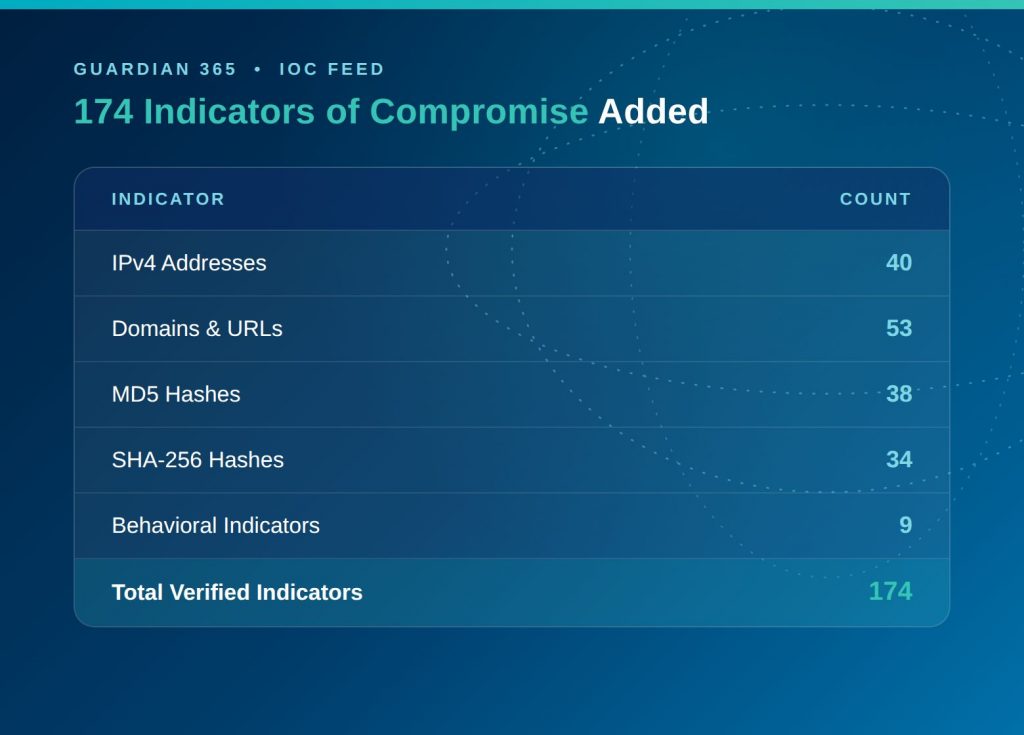
These indicators span activity associated with Ababil of Minab, Black Shadow, Handala, Void Manticore, Nimbus Manticore, Screening Serpens, CyberAv3ngers, APT34 (OilRig), and Seedworm (MuddyWater).
Detection coverage includes Microsoft 365, Microsoft Entra ID, Microsoft Intune, Active Directory, internet-facing applications, and managed endpoints.
How Guardian 365 Protects Against Nation-State Threats
Beginning July 27, 2026, Guardian 365 customers enrolled in the IOC Feed will receive automated deployment of the latest verified indicators across supported environments. Customers receive deployment confirmation shortly after rollout — no additional action required. That’s security working quietly in the background, the way it should.
Beyond the IOC Feed, Guardian 365 Threat Advisories provide practical guidance for implementing Conditional Access policies, Microsoft Defender detection rules, Microsoft Sentinel analytics, mail flow protections, and other controls tailored to your environment. Because every institution and agency operates differently, our team reviews these controls with you before anything is deployed. No surprises — just security that fits how you work.
Protect Your Microsoft 365 Environment
Iranian cyber operations continue to evolve, but the objectives stay consistent: compromise identities, establish persistence, and quietly access valuable information.
You don’t have to figure out your exposure alone. A free security assessment gives you a clear picture of your risk across Entra ID, Defender XDR, Active Directory, Microsoft Intune, and your internet-facing applications — so you know exactly where you stand and what to prioritize.
We Make Security Easy. Because your mission is too important for security to get in the way.
Ready to make security easy?
Find out where your organization stands. Our free security assessment gives you a clear picture of your current posture and a roadmap for what comes next.