

When Your Device Management Platform Becomes the Weapon: Lessons from the 2026 Stryker Cyberattack
Share this post
Author
Security Alert
In early 2026, a cyberattack against a major US corporation resulted in attackers using legitimate Microsoft Intune administrative controls to remotely wipe thousands of managed devices — including personal BYOD devices belonging to employees. No custom malware was required. The attackers used the organization’s own tools against it.
For IT and security leaders in education and government, this attack is not an abstract corporate concern. It is a direct blueprint for how your own Unified Endpoint Management (UEM) infrastructure could be turned against your institution — disrupting operations, destroying data, and affecting thousands of students, employees, and constituents.
What Happened
In March 2026, a destructive cyberattack targeted a major US-based organization with government contracts. The attackers gained privileged administrative access to the victim’s Microsoft Intune environment — their centralized platform for managing laptops, mobile devices, and other endpoints across the organization.
Once inside the Intune control plane, the attackers issued mass remote wipe commands across the managed device fleet. The attack is consistent with a living-off-the-land (LOTL) technique: rather than deploying external malware, the attackers simply used the native, legitimate administrative capabilities of the platform to achieve a catastrophic destructive outcome.
The impact extended beyond corporate-owned devices. Personal devices enrolled in the company’s BYOD (Bring Your Own Device) program were also affected — employees lost access to their personal data because the organization’s MDM enrollment agreements granted the right to wipe enrolled devices during a security incident. When attackers inherit admin rights, they inherit all of those rights.
Why Education and Government Are High-Risk Targets
The threat landscape
State-sponsored and hacktivist threat actors have significantly escalated offensive cyber operations in 2026, driven by ongoing geopolitical tensions. US-based organizations with government contracts, public institutional profiles, or connections to critical infrastructure are actively targeted.
Education institutions and government agencies meet multiple targeting criteria simultaneously:
- Political leverage value — attacks on schools and public agencies generate immediate public pressure and media attention
- Large managed device footprints — school districts and state agencies often manage thousands of endpoints, making mass-wipe attacks disproportionately damaging
- BYOD enrollment at scale — many districts and agencies manage employee- and student-owned devices, dramatically expanding wipe scope
- Limited security staffing — fewer dedicated security engineers to implement and monitor hardening controls
- High data sensitivity — student records, constituent PII, and government data carry significant regulatory and reputational stakes
How Intune Becomes a Weapon
Microsoft Intune is widely deployed in both K-12 and higher education environments, as well as across state and local government agencies. It is an excellent platform — but its power is the risk. An attacker with administrative access to Intune can:
- Issue remote wipe or retire commands to any enrolled device — corporate, government-issued, or personal
- Deploy malicious scripts or applications to managed endpoints
- Relax compliance policies and security baselines across the entire device fleet
- Extract device inventory, user identity data, and configuration information
- Establish persistent access through scheduled tasks, PowerShell scripts, or malicious app packages that appear to originate from legitimate management infrastructure
Because all of these actions flow through native platform controls, they frequently bypass conventional endpoint security detections. By the time alerts fire, the damage may already be done.
A note on BYOD in education
Many school districts and universities enroll student and faculty personal devices into their MDM programs to manage app access and compliance. Standard MDM enrollment terms typically grant the institution the right to remotely wipe enrolled devices. In an attack scenario, an adversary who compromises Intune inherits those same rights — and may exercise them across every enrolled device, regardless of whether it is district-owned or a student’s personal laptop.
Reviewing BYOD enrollment policies and transitioning to Selective Wipe (which removes only corporate data, not personal content) is a meaningful risk reduction step that costs nothing to implement.
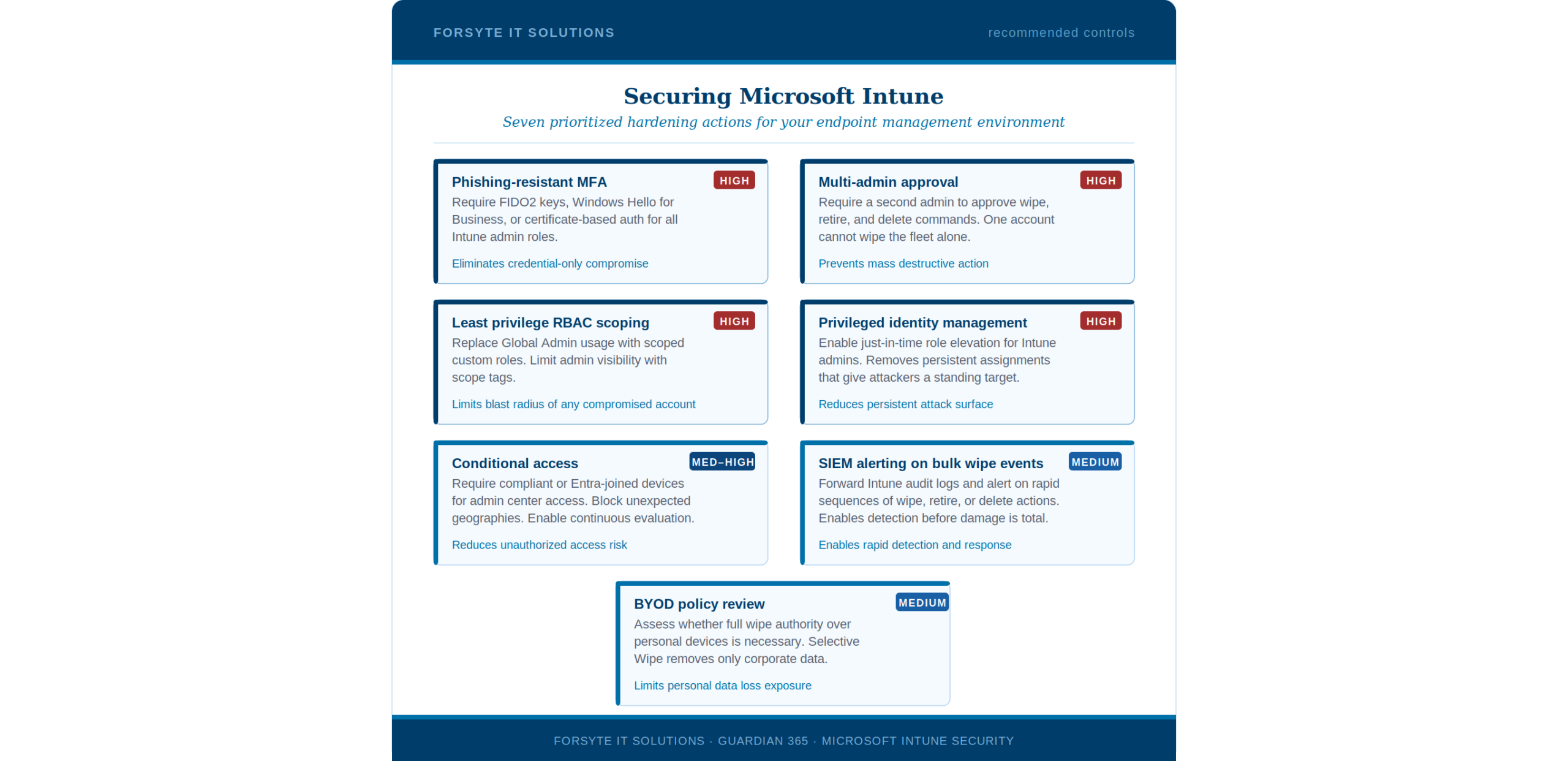
Seven Controls That Reduce Your Exposure
The following hardening actions are prioritized based on the techniques observed in this class of attack and best practice guidance from Microsoft and CISA. Several can be implemented immediately without additional licensing cost.
One Critical Caveat
All of the above controls provide meaningful, layered protection — but it is worth stating clearly: a successful compromise of a Global Administrator account would render most of them largely ineffective. The controls above make your environment significantly harder to attack and significantly noisier to operate in. However, protecting the Global Administrator credential itself — with phishing-resistant MFA, strict conditional access, and privileged identity management — remains the foundational requirement.
If your institution has not reviewed Global Administrator credential hygiene recently, that review should happen before or alongside any other Intune hardening work.
What to Do This Week
If you manage Microsoft Intune in an education or government environment, three actions are worth prioritizing immediately:
- Audit your Intune role assignments. Identify any Global Administrator or Intune Administrator accounts that have persistent, standing role assignments — especially service accounts or shared credentials.
- Review your BYOD enrollment policy. Determine whether full device wipe rights over personal devices are explicitly documented and whether Selective Wipe is a viable operational alternative.
- Verify your audit log pipeline. Confirm that Intune audit events are flowing to a SIEM or alerting platform, and that someone is responsible for reviewing high-impact events like bulk device actions and new role assignments.
Is your Intune environment protected against this attack class?
Our security team can assess your current Intune and Entra ID posture, identify gaps against the controls described in this article, and support implementation at no additional licensing cost for many of these changes.
Ready to make security easy?
Find out where your organization stands. Our free security assessment gives you a clear picture of your current posture and a roadmap for what comes next.